-
What is a commonwealth? There’s no difference between a commonwealth and a state. The name emphasizes its intent to be for the common good of the people.
The convention for this name began when England established charters for new colonies throughout the United Kingdom. Several “states” in the US have kept the designation as Commonwealth. Which ones are they?
Kentucky, Massachusetts, Pennsylvania and Virgina.
-
The Continental Congress was initially convened in 1774 for only eight weeks, in an attempt to have all the colonies represented in a response to laws imposed on the colonies by the British government. That Congress is often referred to as the First Continental Congress.
The Second Continental Congress was convened in 1775. This body did the work of declaring independence in 1776, signing and distributing the Declaration of Independence throughout the colonies, and managing the young nation during the Revolutionary War.
As the war drew to a close the Articles of Confederation were drawn up and signed. The Confederation Congress convened and remained in place from 1781 to 1789.
The Congress as we know it today began after the signing of the US Constitution in 1789. The first session of Congress began in 1789, and the 119th session began in 2025.
The Declaration of Independence and the Constitution have served as models for other democracies over the last two and a half centuries.
-
The Quartering Act was an act of the British Parliament that created hardship and resentment in the Colonies. It specified that the colonists must supply food and lodging for the soldiers of the British Army. This was done to reduce the costs to Britain as they defended the territory and to recoup the costs from the French and Indian War, which took place from 1754 to the 1763.
There was more than one effort by the British Parliament to force the colonies to pay for the British troops stationed in their towns. The first was in 1765, and the second was in 1774.
-
The Stamp Act was a form of tax on the colonists established by the British in 1765. It required all paper used for various documents - including everything from legal papers to newspapers to playing cards - to have a duty tax paid and stamped on the paper.
This Stamp Act was repealed (canceled) in 1766, but similar stamp requirements still occur in many nations. U.S. examples today include a fee for a marriage license, business licenses, and recording fees for deeds and mortgages.
-
Item Many terms were used to describe colonials as tensions escalated before and during the Revolutionary War. These are some of the most common terms.
For colonials who favored independence from the British:
· Patriots
· Whigs, a term borrowed from British politics
· Revolutionaries
· Rebels, a term used by the British
For colonials who preferred to remain under British rule:
· Tories, again a term borrowed from British politics
· Loyalists, those loyal to the British Crown
· Royalists, supporters of the monarchy and British Rule
· King’s Men, those loyal to King George III
-
What were things like growing up in the 1700s?
Let’s answer one question right off the bat…. Kids needed to do their chores. What your chores were depended on whether your lived on a farm or in the city. Chores you do today might include mowing the lawn, taking out the garbage, dusting, vacuuming, and putting the dishes in the dishwasher. In 1776 you could have dusted. And the cows and sheep were the lawn mowers!
To be clear, there was no electricity anywhere in 1776, except maybe in lightning bolts. Nowadays you might run the dishwasher, but in 1776 you would have been the dishwasher. No way you’d be vacuuming either. More likely you’d be using a rake to clean out the horse stalls, feeding the chickens and milking the cows, spinning wool into yarn or thread, weaving, sewing clothing (by hand!), knitting socks, or churning the milk to make butter.
And let’s talk about water….. indoor plumbing and running water didn’t become a thing until the early 1900s. Before that, water had to be collected in barrels (or cisterns) on the roof, pumped out of the river or lake for large quantities, or carried in buckets from the lakes, streams or wells. The kids were often given the task of toting water around. The side benefit? You only had to bathe once a week!
What about education in 1776? If they were wealthy, the signers of the Declaration grew up being homeschooled. Homeschooling usually meant they had a tutor who would give them assignments and review their lessons on a regular basis. Sometimes your tutor was actually a mom or dad or uncle. Some of the signers attended Harvard or Yale starting at the age of 16! Can you name one?
Most students learned only very basic arithmetic, reading, and writing at home…. Just enough to become a farmer or manage a business. Later, Michigan’s laws required a town to provide a schoolmaster if their population was 50 or more, but that law wasn’t passed until 1827, while Michigan was still just a territory.
-
If you lived in what is now western Michigan. in 1776 there were very few people of European heritage. Indian tribes used the rivers and Great Lakes to go between settlements from lower Michigan to Canada, while French missionaries often accompanied them. Fur trappers often followed these same routes themselves. Chicago and Detroit were both simple fur trading posts, growing in population and wealth when better transportation - the Erie Canal and railroads - was available and settlers began to migrate west from the original 13 colonies to seek their fortunes.
What trading was done in those trading posts? Trappers, both Native American Indians and those of European descent, traded furs for money or other goods. Typical items to be traded as compensation for furs might have been blankets, food, rifles and ammunition mainly for the purpose of hunting. The furs were then shipped off to cities all over the world. In time, the attraction of trapping and hunting caused the population of beavers and other animals with valuable pelts to decrease so much that fur trading was no longer feasible.
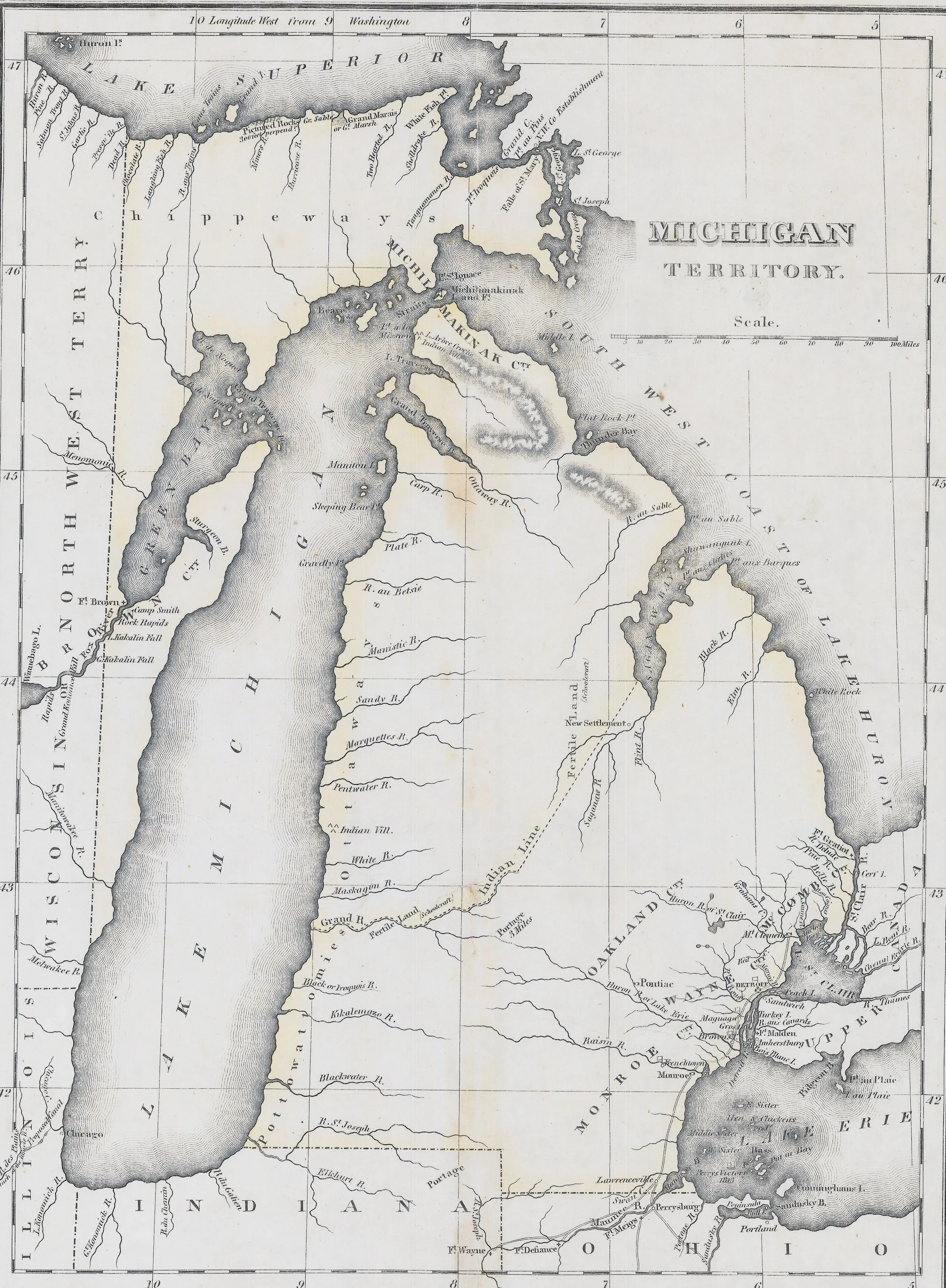
See the map of the Michigan territory of 1822, drawn by a French map maker. This is an early map showing Michigan as a territory. That map maker knew his customers’ needs! Any good trapper that wants to sell pelts needed to know where the rivers and lakes were!
Michigan became a state 15 years later, in 1837.
European American settlers in Western Michigan first lived at the south end of Lake Michigan and gradually came further north as they saw the forests and streams, suitable for harvesting lumber and shipping it across the Great Lakes. Charles Mears was one of these men, growing up in New England and working in his father’s shipping business on the Erie Canal. In the 1830s he and his brothers began a General Store in Paw Paw, Michigan. Later, Charles moved north up the coast of Lake Michigan, buying land and harvesting the timber, milling it, and shipping the planks and shingles to Chicago and Milwaukee. Mears arrived in Oceana County in the 1850s.
When men like Charles Mears started their lumber businesses, they were soon followed by other men who took jobs to cut the timber, work the mills, load the lumber and ship it to other cities, cook for the workers and build stores and boarding houses and homes. Single men married and became families, small camps became settlements which in turn became villages and towns and cities. While Mears was born in New England, many of the men that came to Western Michigan after him were recent immigrants from Northern European countries. We know of Irish, German, Scottish, British, Swedish, Norwegian, Danish and Dutch immigrants, to name a few. A common saying in Grand Rapids and Holland is “If you ain’t Dutch you ain’t much.”
Today people still come to Western Michigan for jobs, but even more people come because of its beauty and summertime weather. When did your ancestors come to Michigan?
-
This 1822 map of the Michigan Territory, while comically misshapen, clearly shows "Pentwater R" at about the point where Pentwater, the Village, settled in 1853, is today.
Flags
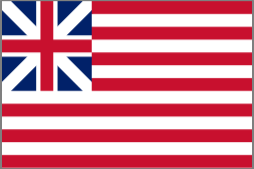
Flag 1 The Continental Union Flag, in use from 1775 to 1776. It greatly resembled the flag of the East India Company, a primary supplier of goods to the North American colonies. This flag showed a willingness to remain a part of the British Empire.
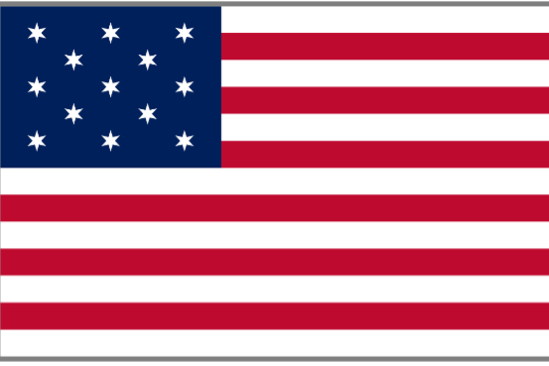
Flag #2 Hopkinson Flag, designed for the US Navy in 1777, with 6-pointed stars. Letters requesting reimbursement were submitted by Hopkinson to Congress to authenticate his design.
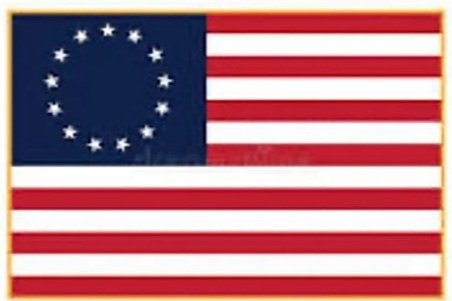
Flag #3 “Betsy Ross flag,” a circular configuration of 5-sided stars.
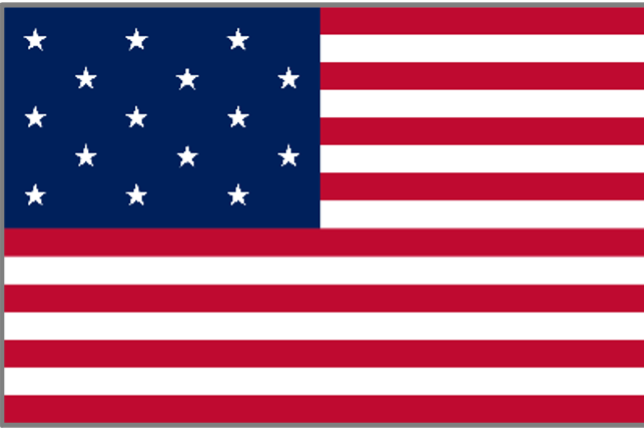
Flag #4 Two stars and two stripes were added in 1795, after the admission of the states Vermont and Kentucky.