Other Revolutionary War Figures
-
George Washington was famous! Why wasn’t he a signer of the Declaration?
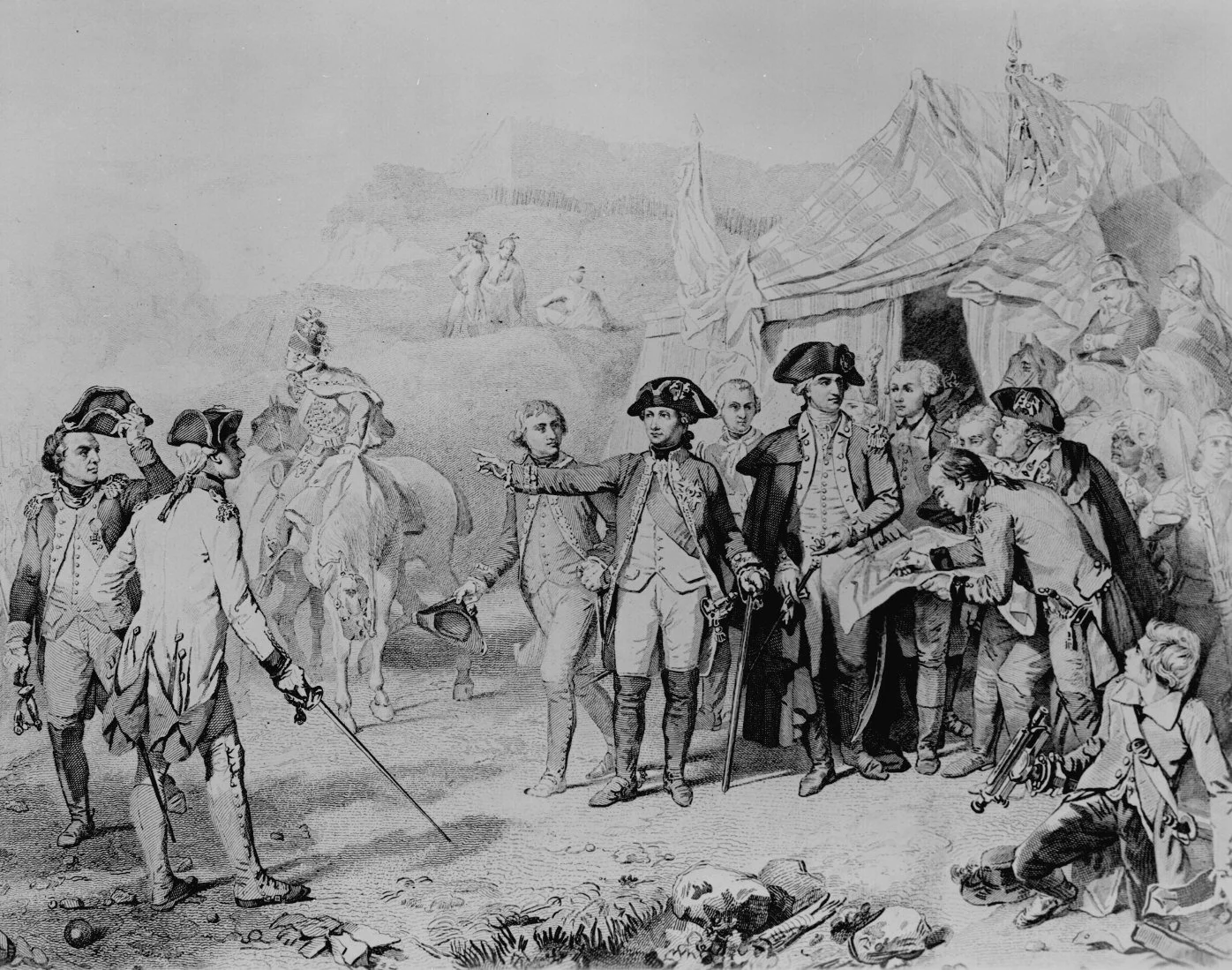
George had trained to be a surveyor, and in 1749 began surveying for government expeditions. Respected for his endurance and ingenuity, he eventually gained a military commission and served as the commander of the Virginia Regiment. Even with his demonstrations of courage and strategy, as a colonist he was denied a Royal Commission to the British Army, possibly souring him on British rule.
He was appointed as Commander-in-Chief of the Continental Army in 1775, serving in that role until 1783 when the peace was declared. His prior military success gained him the respect of the Congress, and being a Virginian was helpful in unifying the colonies under one army.
Of course, he then went on to become our first President.
Did he really have wooden teeth, and did he really chop down a cherry tree and confess to his father? Definitely not, and probably not. As a teenager he did compile a booklet called “Rules of Civility” with over 100 ideas for polite behavior. Maybe this contributed to his reputation for truth-telling.
-
Benedict Arnold was one of the most capable generals of the American Revolutionary War and later became its most infamous traitor. Early in the conflict, he helped capture Fort Ticonderoga in 1775 and played a key role in delaying a British advance from Canada in 1776. Trusted by General George Washington, he was given command of the American fort at West Point, New York.
Despite his successes, Arnold grew increasingly frustrated by financial difficulties, political disputes, and what he believed was a lack of recognition for his service. In 1779–1780, while commanding the fort at West Point, he secretly negotiated with the British to surrender the post in exchange for money and a commission in the British Army. The plot was uncovered after British officer Major John André was captured carrying incriminating documents. Arnold escaped to British lines, and West Point remained under American control.
Today, Benedict Arnold is remembered both for his important contributions to the American war effort and for his betrayal, which made his name synonymous with treason in the United States.
-
Marie-Joseph-Paul-Yves-Roch-Gilbert du Motier, a French nobleman known as the Marquis de Lafayette (1757–1834), was just nineteen years old, he traveled to America in 1777 and was appointed a major general in the Continental Army. Although young and inexperienced, Lafayette quickly earned the trust of General George Washington, who became both his mentor and close friend.
Lafayette first distinguished himself at the Battle of Brandywine in 1777, where he was wounded while helping organize an orderly retreat. He later served at Valley Forge and became one of Washington’s most reliable officers. In 1781, Lafayette commanded American forces in Virginia. His troops helped to limit British troop movements and later helped trap the British General Cornwallis at Yorktown.
Beyond his military service, Lafayette used his influence in France to encourage greater French support for the American cause. French troops and naval assistance proved decisive in the Yorktown campaign, which led to the British surrender and effectively secured American independence. Because of his service to both the United States and France, Lafayette is often remembered as the “Hero of Two Worlds.”
-
Patrick Henry was an influential voice urging resistance to British rule before the American Revolutionary War. A lawyer and member of Virginia's House of Burgesses, Henry denounced the Stamp Act, arguing that Parliament had no right to tax the American colonies without representation. He became a leading advocate for colonial rights and self-government.
On March 23, 1775, at the Second Virginia Convention in Richmond, Henry argued that peaceful efforts to resolve disputes with Great Britain had failed and that Virginia should prepare a militia for defense. He concluded with the famous words, “Give me liberty, or give me death!” The speech helped persuade delegates to support military preparations only weeks before the battles of Lexington and Concord began the Revolutionary War.
The exact text of Henry’s speech was reconstructed decades later from eyewitness recollections, but historians generally agree that Henry's speech played a significant role in rallying support for the American cause and became a lasting symbol of the fight for liberty.
Note: the Virginia House of Burgesses was first established in Jamestown in 1619, and was the first example of a democratic legislative body in America. It was dissolved in 1776 as Virigina moved to become the Commonwealth of Virginia, and replaced by the House of Delegates, the lower house of the Virginia legislature that still exists today.
-
Thomas Paine was one of the most influential writers of the American Revolution. Born in England, he immigrated to the American colonies in 1774 with a letter of introduction from Benjamin Franklin. As tensions between Great Britain and the colonies increased, Paine used his writing to argue for colonial rights and independence.
In January 1776, Paine published the pamphlet “Common Sense,” which became one of the most widely read works in colonial America. Written in clear, direct language, it challenged the authority of the British monarchy and argued that the colonies should become an independent nation. Paine rejected the idea that kings ruled by divine right and claimed that self-government was a natural right of the people.
The pamphlet helped transform public opinion by persuading many colonists who had previously favored reconciliation with Britain to support independence. Historians consider Common Sense a major factor in building support for the movement that led to the Declaration of Independence later in 1776. Through his writing, Paine helped shape the political ideas that inspired the American Revolution.
-
Ethan Allen (1738–1789) was a frontier leader, militia commander, and prominent figure in the American Revolution. Before the war, Allen became the leader of the Green Mountain Boys, a militia organized in the disputed New Hampshire Grants (present-day Vermont) to resist New York’s claims to local land titles.
At the outbreak of the Revolution, Allen and the Green Mountain Boys achieved one of the Patriots’ earliest victories by capturing Fort Ticonderoga in May, 1775. The fort’s artillery soon proved valuable to the American war effort.
Later that year, Allen participated in an unsuccessful attempt to seize Montreal. He was captured by British forces and remained a prisoner until 1778.
Although remembered as a Revolutionary War hero, historians note that Allen’s significance also lies in his leadership during Vermont’s struggle for self-government.
-
According to historians, Paul Revere's famous ride of April 18, 1775, did not end in Concord, Massachusetts. After warning Samuel Adams and John Hancock in Lexington, Revere continued toward Concord with William Dawes and Samuel Prescott. Along the way, the three men encountered a British patrol. Revere was captured, questioned, and detained for several hours. Revere’s horse was confiscated, and he was eventually released on foot.
He probably did not shout “The British are coming” throughout the towns and roads since most of the colonists were in fact British. Instead, he may have just warned that the troops were coming.
After returning to Lexington, Revere helped remove important papers belonging to Hancock and assisted Patriot leaders as British troops approached. He was present in the area when the opening engagements of the Revolutionary War occurred later that day on April 19, 1775.
Revere continued serving the Patriot cause throughout the war. He worked as a messenger, helped produce military supplies, and later served as a lieutenant colonel in the Massachusetts militia artillery.
After the Revolutionary War, Revere returned to his trade as a silversmith and became a successful entrepreneur, expanding into metalworking and manufacturing, operating a foundry and later establishing one of the first successful copper mills in the United States. He also held several public positions in Boston, including county coroner and member of the city's Board of Health.